
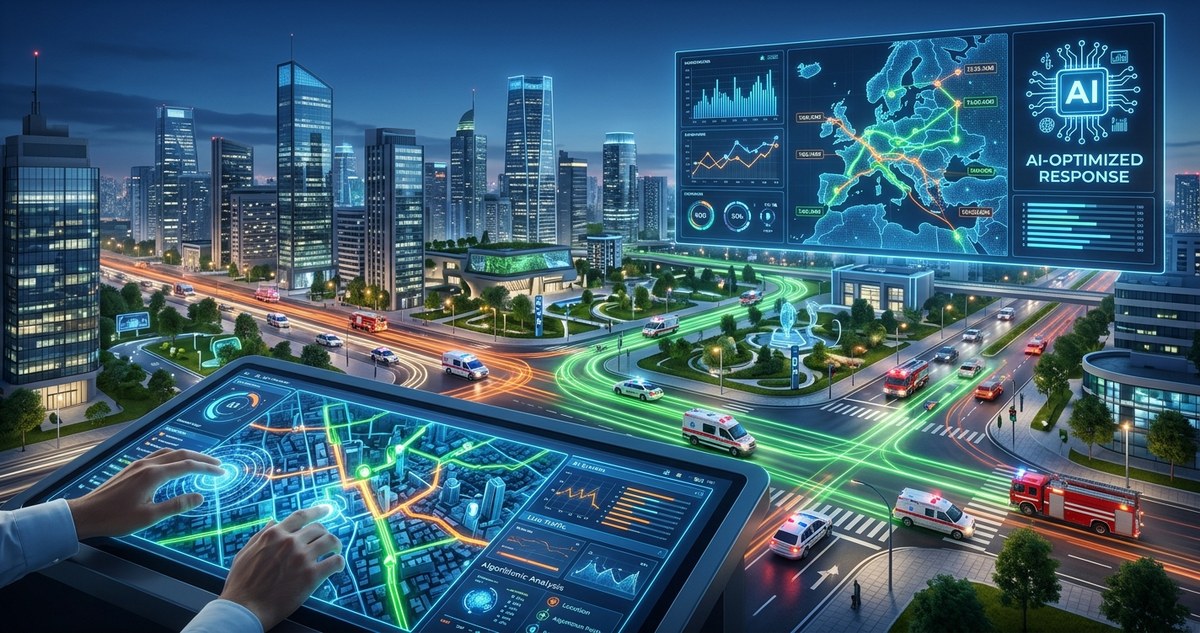
In a dense urban core, every second counts when a 911 call comes in. For decades, dispatchers relied on static maps, radio chatter, and gut instinct. That is changing now. Smart city planners are using artificial intelligence to shave minutes off response times for police, fire, and ambulance services. The result is a system that learns traffic patterns, predicts where incidents will happen, and reroutes vehicles before a driver even knows there is a jam ahead. This is not a futuristic concept. It is happening in cities across the United States right now, and the data shows it is saving lives.
AI optimizes emergency response by analyzing live traffic feeds, historical incident data, and weather conditions to suggest the fastest routes. It also predicts high-risk zones so cities can pre-position ambulances and fire trucks. Urban planners who integrate AI into dispatch systems report response time reductions of 20 to 40 percent, which directly improves survival rates for cardiac arrests and fire rescues.
How AI reshapes the dispatch process
Traditional dispatch systems work in a linear way. A call comes in, a human operator assigns a unit, and the driver picks a route based on experience or a basic GPS. AI changes that by adding layers of real-time intelligence. Here is how the process works in a modern smart city:
- Data ingestion. Sensors, cameras, and connected vehicles feed live traffic information into a central AI platform. The system also pulls in weather data, event schedules, and historical call patterns.
- Predictive modeling. The AI identifies areas with a high probability of incidents based on time of day, day of the week, and past trends. It flags these zones to dispatchers.
- Dynamic routing. When a call comes in, the AI calculates multiple routes and updates them every few seconds. It accounts for construction, accidents, and even the timing of traffic lights.
- Real-time reassignment. If a primary unit gets stuck in unexpected congestion, the system automatically reassigns the closest available unit. Dispatchers see the recommendation and can approve it with one tap.
- Post-incident learning. The AI logs the outcome and adjusts its models. Over time, it gets better at predicting both demand and travel time.
This cycle runs continuously. Every call makes the system smarter.
The three pillars of AI-driven emergency response
To understand how planners are building these systems, it helps to break down the technology into three core areas.
Predictive deployment
Cities like Los Angeles and Chicago now use AI to decide where to station ambulances during peak hours. Instead of keeping all units at fixed stations, the system suggests temporary positions based on where the next incident is likely to occur. This is called dynamic deployment. It reduces average travel distance and gets help to the scene faster.
Traffic signal preemption
One of the most powerful tools is AI-controlled traffic signal preemption. When an emergency vehicle approaches an intersection, the system turns the light green and holds conflicting reds. Older systems did this with simple radio triggers. AI improves it by adjusting the timing based on the vehicle’s speed, direction, and the current traffic load. This prevents secondary accidents at intersections and keeps the emergency vehicle moving.
Integrated communication
AI platforms now unify data from police, fire, and medical dispatch. A single dashboard shows the location of every unit, the status of each call, and the predicted time of arrival. This breaks down the old silos where each agency worked in isolation. When a fire truck and an ambulance are heading to the same scene, the AI coordinates their arrival so they do not block each other.
What urban planners should watch for
Not every AI deployment goes smoothly. Some cities have run into problems that are worth noting. The table below outlines common techniques and the mistakes that can undermine them.
| Technique | Common mistake | Better approach |
|---|---|---|
| Predictive deployment based on historical data | Relying only on old call records without factoring in new construction or event changes | Update the model weekly with fresh data from building permits and city event calendars |
| Traffic signal preemption | Preempting signals for every emergency vehicle without priority tiers | Assign priority levels so life-threatening calls get preemption over non-urgent transports |
| Integrated dispatch dashboards | Overloading dispatchers with too many alerts and recommendations | Use a simple visual cue system (green, yellow, red) and let the AI handle the details |
| Real-time route optimization | Ignoring road conditions like potholes or temporary closures | Connect the AI to a live road maintenance feed so it avoids hazards |
A real-world example from a mid-sized city
Consider what happened in Austin, Texas, in 2025. The city partnered with a local university to test an AI dispatch system for its emergency medical services. Over a six-month trial, the system analyzed traffic data from connected vehicles and city sensors. It also learned patterns from 10 years of incident records. The AI recommended stationing an extra ambulance near the entertainment district on Friday and Saturday nights. Response times for cardiac arrest calls in that zone dropped by 31 percent. The city has since expanded the program to cover fire and police responses.
“The biggest surprise was how much the AI improved during the trial. It learned that a popular taco festival caused a two-hour traffic spike that we never accounted for in our manual planning. The system caught it after one event and adjusted for the next one.”
Austin EMS operations manager, 2026
Key technologies that make it possible
AI does not work in a vacuum. It depends on a network of supporting technologies. Here are the main ones planners need to know about:
- IoT sensors. Road sensors, cameras, and weather stations feed real-time data into the AI model.
- Edge computing. Processing data at the edge reduces latency. A traffic light that waits for a cloud server to respond is too slow for emergency preemption.
- Digital twins. Some cities build a digital twin of the road network. The AI runs simulations on the twin before deploying changes in the real world. This is covered in detail in our article on are digital twins the key to smarter infrastructure maintenance in 2026.
- 5G connectivity. Low-latency 5G networks allow vehicles and traffic infrastructure to communicate in milliseconds. For more on this, read how 5g networks are enabling real-time smart city operations.
- Data integration platforms. These platforms pull data from different city departments and standardize it for the AI. Our piece on how smart city data platforms are breaking down silos in urban governance explains how this works.
Measuring success beyond seconds saved
Response time is the obvious metric, but it is not the only one. Planners should also track:
- Survival rates. For cardiac arrest and stroke calls, every minute matters. A reduction in response time directly correlates with higher survival rates.
- Fuel savings. Shorter routes mean less fuel burned. This supports sustainability goals and reduces operating costs.
- Dispatchers workload. AI should reduce cognitive load, not add to it. Survey dispatchers to see if they feel less stressed.
- Equity of response. AI models can inherit bias from historical data. If past response times were slower in certain neighborhoods, the AI might perpetuate that. Regular audits are essential. Our article on can predictive policing algorithms make smart cities safer without sacrificing civil liberties discusses similar concerns.
Common pitfalls and how to avoid them
Cities that rush into AI deployment often hit the same walls. Here are the most frequent issues and practical fixes.
Data quality problems
Garbage in, garbage out. If the traffic sensors are poorly calibrated or the call logs are incomplete, the AI will produce bad recommendations. Fix this by running a data audit before you start. Clean the data. Fill gaps with synthetic data if needed.
Over-reliance on automation
Dispatchers should stay in the loop. AI is a tool, not a replacement. The best systems present recommendations and let humans make the final call. This builds trust and catches edge cases the model has not seen.
Privacy concerns
Cameras and sensors raise privacy questions. Be transparent about what data you collect and how long you keep it. Anonymize vehicle and pedestrian data when possible. A clear privacy policy builds public support.
Vendor lock-in
Some AI platforms are proprietary and difficult to integrate with existing systems. Choose vendors that use open standards and APIs. This gives you flexibility to switch or upgrade later.
Building a smarter emergency response system step by step
If you are an urban planner looking to bring AI into your city’s emergency response, here is a practical path.
- Start with a pilot. Pick one district or one type of response, like ambulance dispatch. Run the AI alongside the existing system for three months. Compare results.
- Involve frontline staff. Dispatchers and drivers know the streets better than any algorithm. Get their input on the model and the interface. They will spot problems the data does not show.
- Invest in data infrastructure. The AI is only as good as the data it receives. Upgrade your sensor network and ensure data flows in real time.
- Test for bias. Audit the model to make sure it serves all neighborhoods equally. Adjust the training data if you find disparities.
- Scale gradually. Once the pilot proves itself, expand to other services. Each expansion will teach you something new.
For a broader look at how data analytics supports urban planning, see harnessing data analytics for smarter urban infrastructure design.
The road ahead for AI and emergency response
The technology is moving fast. By 2027, we will likely see AI systems that can communicate directly with autonomous vehicles, clearing a path for an ambulance without any human input. We will also see models that predict not just where incidents will happen, but what type of incident it will be, so the right equipment and personnel are sent from the start. Cities that invest now will have a head start.
The goal is simple. Use every tool available to get help to people who need it as fast as possible. AI is one of the most powerful tools we have. When it is designed well and deployed thoughtfully, it turns data into saved minutes, and saved minutes into saved lives.
If your city is ready to take the next step, start with a small pilot, involve the people who do the work every day, and keep the focus on outcomes that matter. The technology is ready. The question is whether we are ready to use it wisely.









Leave a Reply