
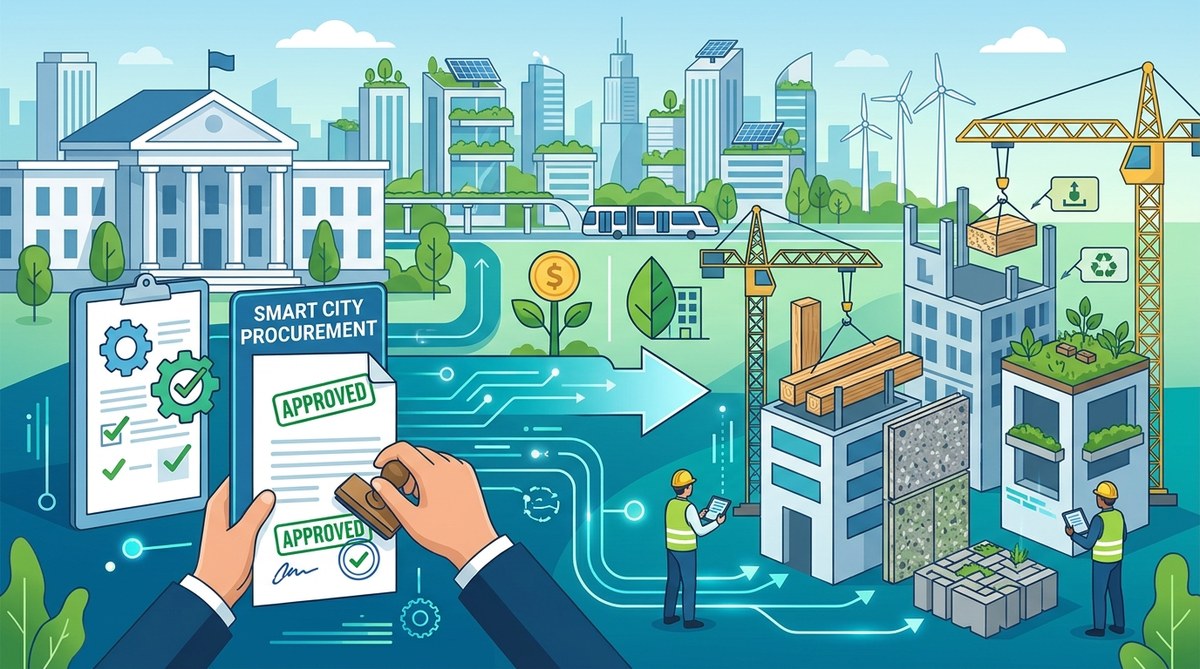
Cities are buying things all the time. Sidewalks, streetlights, public housing, municipal buildings. Every purchase is a choice. And every choice shapes the city for decades. For urban policymakers and sustainability officers, the question is no longer whether green building materials are better. It is how to get them specified, approved, and installed at scale. The answer lives inside the procurement office. Smart city procurement policies are the lever that can move the market for green building materials from niche to normal.
Public procurement influences roughly 45% of global construction spending. By rewriting bid specs, cities can create demand for low carbon concrete, recycled steel, and bio based insulation. This article shows how to embed green criteria into every stage of the purchasing cycle, avoid common pitfalls, and turn taxpayer dollars into climate action.
Why procurement matters more than codes
Building codes set a floor. Procurement sets a ceiling. When a city writes a contract for a new library, it can require recycled content aggregate, low VOC paints, and locally sourced timber. It can ask for third party certifications like Cradle to Cradle or Environmental Product Declarations. The market responds. Manufacturers invest in greener production lines because they know there is a buyer waiting.
Consider the example of Los Angeles. In 2024, the city updated its procurement rules to require that all municipal concrete projects use at least 30% supplementary cementitious materials. By 2026, that policy has cut embodied carbon from city funded buildings by nearly 18%. No new law needed. Just a smarter request for proposals.
The three shifts that make it work
A traditional procurement process cares about three things: lowest price, compliance, and delivery speed. To accelerate green material adoption, you need to add a fourth: environmental performance. Here is how to make that shift without slowing everything down.
1. Switch from lowest bid to best value
Lowest bid procurement rewards cheap materials. Those materials are often carbon heavy. Best value procurement scores bids on a weighted scale. Price still matters, but so do carbon footprint, recycled content, and durability.
This approach works because it gives contractors a reason to offer greener options. They compete on innovation instead of just price. Cities like Portland and Vancouver have used best value scoring for years. Their infrastructure projects now routinely include fly ash concrete and reclaimed steel.
2. Embed lifecycle cost analysis
Green materials sometimes cost more upfront. But they last longer. A roof made from cool roofing membrane reduces cooling loads for 30 years. That is a lifetime of energy savings. Smart procurement policies require bidders to submit lifecycle cost data alongside their price.
This shifts the conversation from “how much does it cost?” to “what is the total cost of ownership?” When you factor in maintenance, energy, and replacement cycles, many green materials win on price over the full project life.
3. Use pre approval lists for green materials
Contractors avoid unfamiliar materials. It slows them down and adds risk. Cities can solve this by maintaining a pre approved list of green building materials. Any contractor can use anything on the list without extra paperwork.
This removes the friction. A contractor building a new fire station can choose hempcrete blocks instead of standard CMU because the city already vetted them. No delays. No confusion. Just a faster path to lower embodied carbon.
Common mistakes that slow adoption
Even well intentioned policies can fail. Here are the traps to avoid, and the fixes that work.
| Mistake | Why it happens | The fix |
|---|---|---|
| Writing overly vague specs | Procurement officers fear limiting competition | Use performance based language: “concrete with at least 40% recycled content” |
| Ignoring contractor training | Workers do not know how to install new materials | Include a training allowance in every green material contract |
| Skipping pilot projects | Risk aversion blocks new materials at scale | Start with one park restroom or sidewalk before a full municipal building |
| Failing to track outcomes | No data on whether green specs actually cut emissions | Require carbon reporting as a deliverable in every contract |
A five step process for rewriting your procurement rules
If you are ready to update your city’s approach, here is a practical sequence to follow.
-
Audit your current contracts. Look at the last 20 infrastructure projects your city funded. What materials were specified? Where could you substitute a greener alternative without changing the design? This baseline helps you set realistic targets.
-
Set measurable green criteria. Pick three to five metrics. Embodied carbon per cubic yard. Recycled content percentage. Local sourcing radius. Make them specific and verifiable. “Use low carbon concrete” is too vague. “Use concrete with at least 25% slag cement replacement” is actionable.
-
Train your procurement team. Your buyers know contracts. They may not know about bio based insulation or carbon sequestration. Host a half day workshop with material scientists or green building consultants. Give them a cheat sheet of approved alternatives.
-
Pilot the new criteria on a small project. Choose a maintenance shed, a bus shelter, or a sidewalk replacement. Require the new green specs. Document every hiccup. Use that learning to refine the language before scaling up.
-
Scale to all municipal projects. After one successful pilot, update your standard bid templates. Make the green criteria the default, not the exception. By 2027, every new city building should automatically include green material requirements.
“Procurement is the quietest climate policy you will ever implement. It does not need a vote. It does not need a tax. It just needs a better specification sheet.” * Sarah D. Johnson, former sustainability director for the City of Austin
How to build political support
Green procurement is not controversial. It saves money over time and creates local jobs in recycling and manufacturing. But it still needs champions. Here is how to build a coalition that keeps the policy alive across election cycles.
- Frame it as fiscal responsibility. Lifecycle cost analysis appeals to budget officers.
- Highlight local economic benefits. Recycled content materials often come from regional processors.
- Share visible wins. A new green roof on a city hall is a photo opportunity and a proof point.
- Connect to existing climate goals. Most cities have a climate action plan. Green procurement is a direct implementation tool.
For more on how cities are connecting these dots, read our piece on innovative strategies for building smarter urban infrastructure. It covers how digital tools are helping procurement officers track material performance in real time.
Measuring what matters
You cannot manage what you do not measure. Every green procurement policy needs a feedback loop. Track these numbers from day one.
- Total tons of CO2 avoided through material substitution
- Percentage of contracts that meet green criteria
- Cost variance between green and conventional bids
- Number of contractor requests for alternative materials
Share these metrics publicly. Transparency builds trust. It also pressures other departments to match the performance. When the parks department sees that public works cut embodied carbon by 22% in one year, they will want the same results.
What the private sector can teach us
Cities are not the only buyers pushing for green materials. Large developers and corporate campuses have been doing this for years. Google, Microsoft, and Amazon all require low carbon concrete for their new buildings. Their procurement teams use digital platforms to verify material claims and track supplier performance.
Cities can borrow this playbook. Start a supplier scorecard. Rank vendors on carbon performance, recycled content, and innovation. Publish the rankings. The best suppliers will compete for the top spot. The worst will improve or lose business.
If your city is exploring digital tools for this, you might find inspiration in our article on harnessing data analytics for smarter urban infrastructure design. It shows how data platforms can automate the tracking of green material compliance across hundreds of projects.
The role of state and federal policy
Local procurement works best when it aligns with state and federal incentives. The Inflation Reduction Act and the Buy Clean initiative have created funding streams for low carbon materials. Cities that tie their procurement rules to these programs can access federal dollars to offset any upfront cost premium.
Check if your state has a low carbon concrete procurement law. As of 2026, more than a dozen states have adopted them. If yours is one of them, your city’s policy can simply mirror the state standard. That reduces legal risk and makes compliance easier for contractors who work across jurisdictions.
Looking ahead to 2027 and beyond
The market for green building materials is growing fast. By 2028, the global market is projected to exceed $700 billion. Cities that build green procurement muscle now will be ahead of the curve. They will attract green manufacturers. They will lower their infrastructure costs. And they will meet their climate targets without waiting for federal mandates.
The future of urban development depends on the materials we choose today. If you want to understand the broader trends shaping our cities, take a look at the future of green urban development: trends and technologies to watch. It connects the dots between material choices, urban design, and long term resilience.
A final thought for the people writing the specs
You sit at a desk. You write a paragraph about concrete. That paragraph, if written well, can save thousands of tons of carbon. It can send a signal to a factory across the country. It can make a new material viable. That is real power.
Start small. Update one specification this month. Use it on one project. Measure the result. Show your colleagues. Then do it again. That is how smart city procurement policies accelerate the adoption of green building materials. One spec sheet at a time.









Leave a Reply