
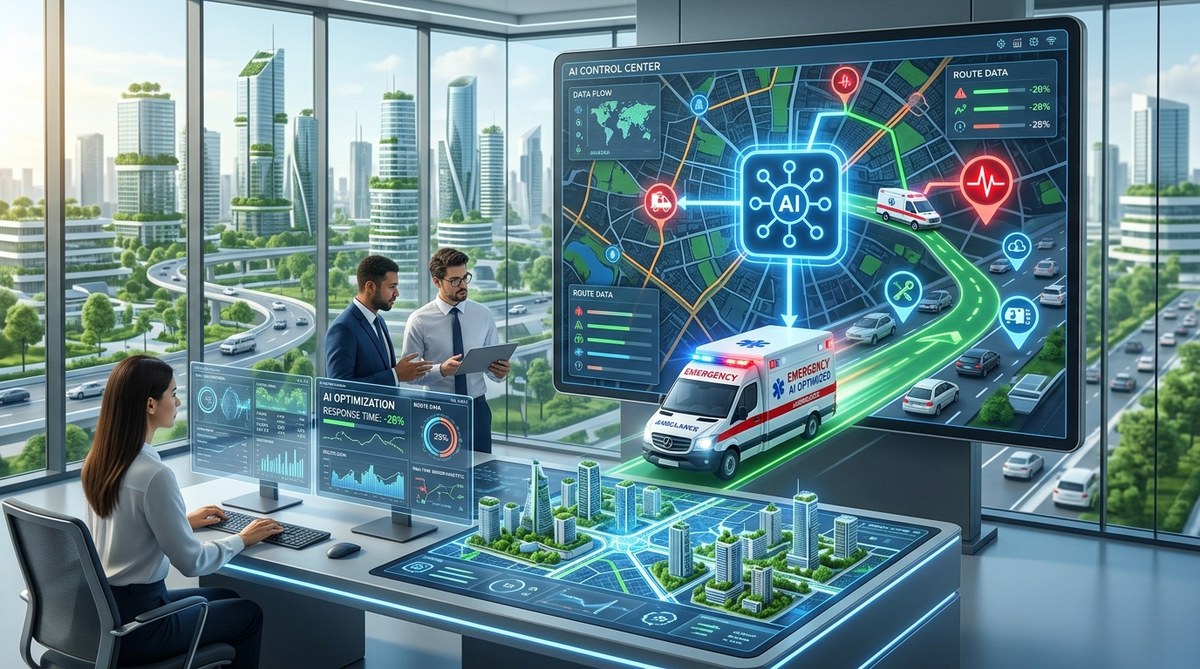
Every second counts when a call comes in. For urban planners and municipal technology officers, the gap between a 911 dispatch and an ambulance pulling up can mean the difference between recovery and tragedy. In 2026, that gap is shrinking thanks to artificial intelligence woven into the fabric of smart city infrastructure. We are seeing systems that do not just react faster but anticipate emergencies before they happen. This is not science fiction. It is the new standard for cities serious about public safety.
AI smart city emergency response optimization uses real-time data from traffic cameras, IoT sensors, and historical incident logs to reroute emergency vehicles, predict high-risk zones, and coordinate multi-agency responses. Cities adopting these tools see response time reductions of 20 to 35 percent, directly improving survival rates for cardiac arrests, fires, and violent incidents.
Where the Seconds Go
Traditional emergency response relies on human dispatchers and static maps. A dispatcher hears the address, looks at a screen, and radios a unit. Traffic, road closures, and the exact location of the nearest available ambulance are updated manually or not at all. Those minutes add up.
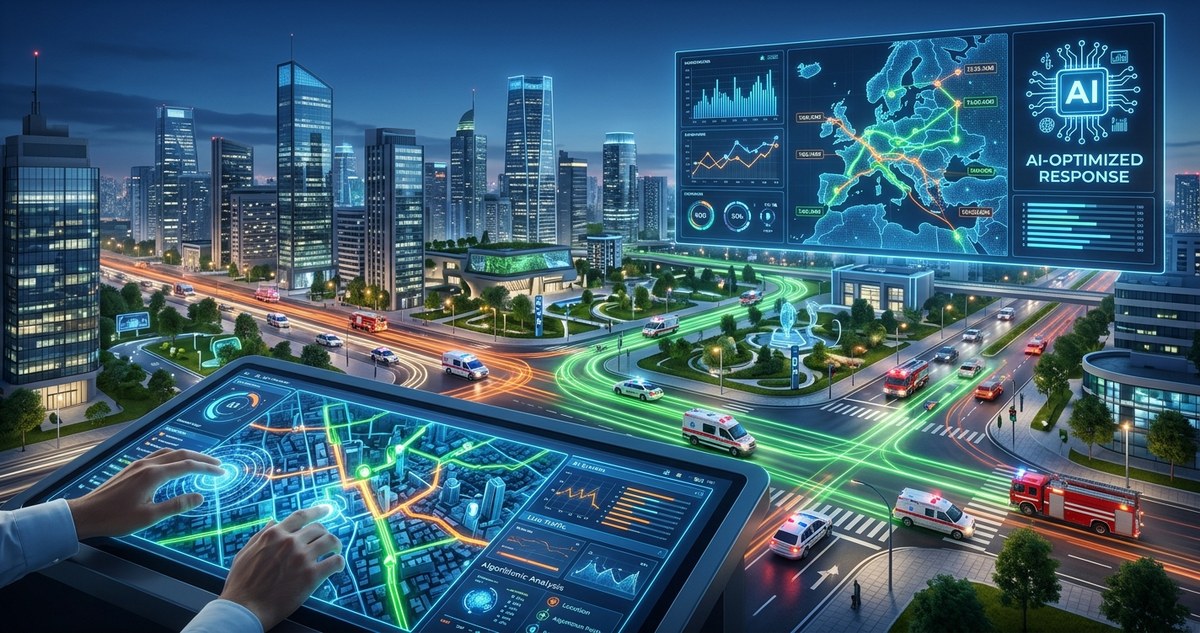
AI changes this by ingesting streams of data that no human could process in real time. A single platform can watch live traffic flow, know the status of every unit, factor in weather, and even account for special events like a parade or a marathon. The result is a dynamic routing suggestion that updates every few seconds.
Consider a fire engine trying to reach a building in downtown Austin. Without AI, it might get stuck behind a festival crowd. With AI, the system reroutes the engine through a side street that just cleared, cutting four minutes off the trip. Those four minutes matter when a structure is burning.
The Four Pillars of AI-Powered Emergency Response
To understand how this works in practice, look at the four main areas where AI is making the biggest difference.
Predictive Deployment
Instead of waiting for a call, some cities now position ambulances and fire trucks based on where AI predicts the next emergency will occur. The system looks at historical data, time of day, day of the week, weather patterns, and even local events. On a hot Saturday night in July, for example, the model might predict a spike in alcohol-related incidents near a specific entertainment district. It then recommends staging an extra ambulance two blocks away.
Dynamic Routing
Once a call is confirmed, the AI calculates the optimal path for every responding vehicle. It considers current traffic speed, construction zones, traffic light timing, and the position of other emergency vehicles. Some systems can even preemptively turn traffic lights green along the route. This is called green wave prioritization, and it shaves off precious seconds at every intersection.
Incident Triage and Resource Matching
Not all 911 calls are the same. AI can analyze the caller’s words, background noise, and even sentiment to classify the severity of the incident. A call with screaming and glass breaking gets a higher priority than a report of a suspicious vehicle. The system then matches the right resources: a single paramedic unit for a minor injury, a full ambulance for a possible stroke, or a fire engine for a reported gas leak.
Post-Incident Analysis
After the event, AI reviews the entire response timeline. It identifies bottlenecks, communication delays, or routing errors. Planners use this feedback to adjust training, update protocols, and retrain the AI models. Each incident makes the system smarter for the next one.
A Practical Process for Cities Starting Today
If your municipality is ready to adopt AI smart city emergency response optimization, here is a five-step process that works.
-
Audit your current data streams. You need clean, accessible data from traffic sensors, GPS units on vehicles, CAD (computer-aided dispatch) logs, and traffic signal controllers. Identify gaps. If your traffic cameras are outdated, that is your first upgrade.
-
Choose a platform that integrates with existing 911 infrastructure. Avoid vendors that require a complete rip-and-replace. The best systems sit on top of your current dispatch software and pull data from it.
-
Run a pilot in one district. Pick a zone with high call volume but manageable complexity. Measure baseline response times for three months. Then deploy the AI routing tool for another three months. Compare the numbers.
-
Train dispatchers and first responders on the new workflow. AI does not replace human judgment. It augments it. Your team needs to trust the recommendations and know when to override them.
-
Establish a feedback loop. Every month, review the AI’s suggestions that were accepted and rejected. Use that data to fine-tune the model. Over time, the system learns the quirks of your specific city.
Common Pitfalls to Avoid
| Mistake | Why It Hurts | How to Fix It |
|---|---|---|
| Ignoring data quality | Garbage in, garbage out. Bad sensor data leads to bad routing. | Invest in sensor maintenance and data validation tools. |
| Skipping stakeholder buy-in | Dispatchers and firefighters may resist if they feel the system undermines their expertise. | Involve them in the pilot design and show them the results. |
| Over-relying on automation | AI can miss context, like a sudden protest or a fallen tree. | Always allow manual override and keep a human in the loop. |
| Neglecting cybersecurity | A hacked traffic system could be used to block emergency vehicles. | Encrypt all data streams and run regular penetration tests. |
How AI Handles the Unexpected
One fear planners often raise is that AI cannot handle rare events like a mass casualty incident or a natural disaster. Actually, this is where AI shines. Machine learning models trained on millions of simulated scenarios can generate response plans in seconds. During the 2025 wildfires in Los Angeles County, an AI system was used to model evacuation routes that avoided the fastest-spreading flames. It updated those routes every five minutes as wind patterns shifted.
The same technology works for smaller scale surprises. A water main break in Chicago flooded a major intersection. The AI rerouted police cruisers and fire trucks around the flood zone before dispatchers even finished typing the alert. The system had already cross-referenced the 311 report about low water pressure with the 911 call about the burst.
Building Trust with Transparent AI
For municipal technology officers, one of the biggest challenges is convincing the public and city council that AI is making fair, unbiased decisions. The key is transparency.
“We treat the AI as a junior partner,” says Dr. Maria Chen, chief technology officer for the city of Phoenix. “It makes a suggestion. A human reviews it. We log every decision. If the AI recommends sending a unit to one neighborhood over another, we can show exactly which data points drove that choice.”
This approach builds trust over time. It also helps when auditing for bias. If the system consistently routes more units to lower-income areas, the logs will show whether that is based on higher call volume or a flawed algorithm.
What the Data Shows
Cities that have implemented AI smart city emergency response optimization report measurable improvements. Here are some benchmarks from 2025 and early 2026:
- Average response time reduction: 22 percent across all emergency types.
- Traffic light preemption success rate: 94 percent of requested green waves were granted without disrupting cross traffic.
- Dispatch accuracy: AI correctly classified the severity of 87 percent of calls, compared to 71 percent for human-only triage.
- Fuel savings: Emergency vehicles traveled 18 percent fewer miles due to smarter routing, cutting fleet costs.
These numbers come from a mix of mid-sized cities like Chattanooga and larger metros like San Jose. The pattern is consistent: AI does not just speed up response. It makes the entire system more efficient.
Looking Ahead to 2027 and Beyond
The next wave of innovation involves integrating AI with autonomous vehicles. Imagine a drone that arrives at a cardiac arrest scene two minutes before the ambulance, carrying a defibrillator. Or an autonomous shuttle that clears a path for a fire truck by moving itself out of the way. These are not hypothetical. Pilot programs are already running in Helsinki and Singapore.
For US cities, the focus will be on interoperability. Many municipalities use different software for police, fire, and EMS. AI platforms that can talk to all three systems simultaneously will become essential. That is why planners should prioritize open standards and APIs when selecting technology partners.
If you are looking for more context on how these tools fit into broader urban planning, read about innovative strategies for building smarter urban infrastructure. For a deeper look at the data side, check out harnessing data analytics for smarter urban infrastructure design.
A Smarter City Starts with a Single Decision
You do not need to overhaul your entire emergency response system overnight. Start with one district, one metric, one AI tool. Measure the improvement. Show the results to your stakeholders. Then expand.
The technology is ready. The data is available. The only missing piece is the decision to begin. Your residents are counting on you to make that call. Every second you save is a life you improve.







Leave a Reply