
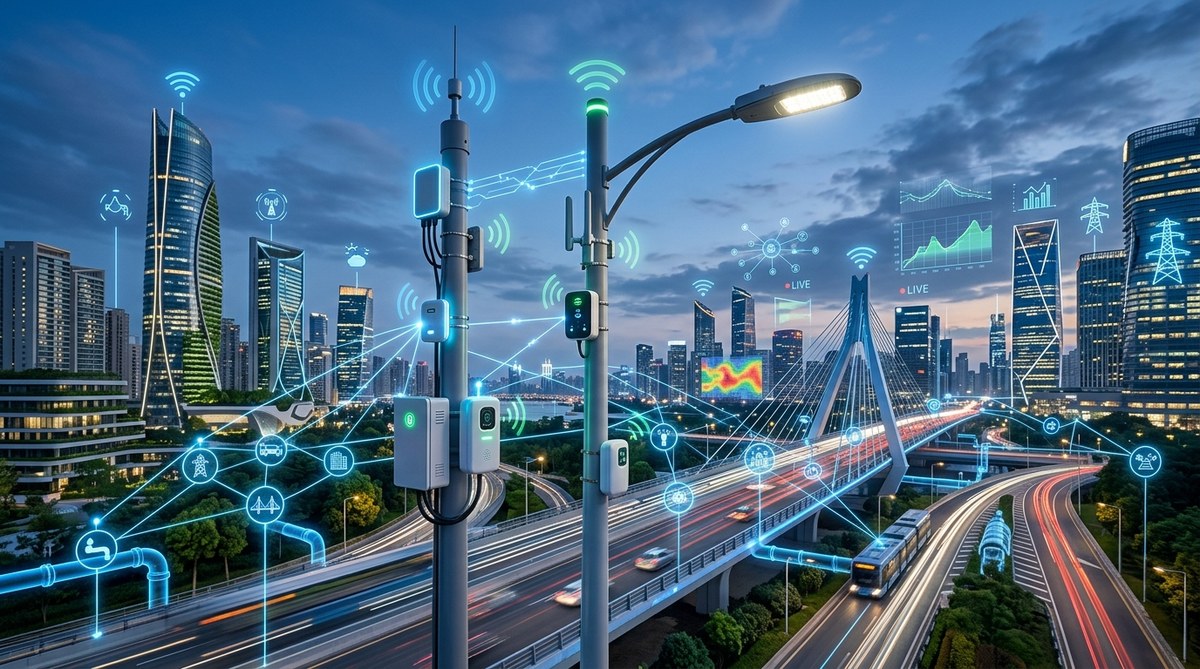
Every city manager I talk to shares the same frustration: aging infrastructure that fails without warning. A water main bursts under a busy intersection. A bridge expansion joint seizes up in the heat. A sewer line collapses after heavy rain. These events disrupt daily life, drain budgets, and erode public trust. But what if you could see the problem forming weeks before it happens? That is the promise of IoT sensors for urban infrastructure monitoring. Tiny, low-power devices placed on bridges, pipes, roads, and buildings can stream data about vibration, temperature, moisture, and stress directly to your dashboard. The technology has matured. The costs have dropped. In 2026, any city can start.
IoT sensors turn reactive maintenance into proactive care. By measuring vibration, corrosion, tilt, and flow in real time, urban teams can spot anomalies early, prioritize repairs, and extend asset life. The upfront cost is offset by preventing one major failure. Start with a pilot on a single critical asset, then scale with lessons learned.
Why real time monitoring matters more than ever
Infrastructure in the United States carries a sobering grade. The American Society of Civil Engineers gives our roads, bridges, and water systems a C-minus overall. In many cities, pipes installed in the 1950s are still in service. The challenge is not just age; it is invisibility. You cannot see corrosion inside a steel support beam or a crack forming under asphalt. Traditional inspections rely on visual checks done every year or two. That leaves huge gaps.
IoT sensors close those gaps. A single accelerometer on a bridge deck can detect unusual vibration patterns that signal structural fatigue. A soil moisture probe near a retaining wall can warn of erosion before a landslide. A pressure sensor on a water main can identify a slow leak that would otherwise waste millions of gallons. When you get alerts in real time, you move from hoping nothing breaks to knowing exactly what needs attention.
Consider a real example from 2025. The city of Austin, Texas, deployed vibration and tilt sensors on a 60 year old highway overpass. Within three months, the system flagged a subtle change in the pier alignment. Engineers inspected and found a failing bearing. They scheduled a replacement during a weekend closure instead of an emergency shutdown. The cost of the sensor network? About $40,000. The cost of an unplanned bridge closure? Over $2 million in lost productivity and detour costs alone. That is the math that makes IoT monitoring an easy sell.
How IoT sensors work in the built environment
An IoT sensor for infrastructure monitoring is a small, battery powered or energy harvesting device that measures a specific physical parameter. It sends that data wirelessly to a gateway, which forwards it to a cloud platform. There, algorithms compare current readings to baselines and trigger alerts when thresholds are crossed.
Different assets need different sensors. Here is a breakdown of common applications:
| Infrastructure Type | Sensor Type | What It Detects | Typical Alert Trigger |
|---|---|---|---|
| Bridges | Accelerometer, tiltmeter | Vibration frequency shift, lean angle | 5% deviation from baseline vibration |
| Water pipes | Acoustic sensor, pressure transducer | Leak noise patterns, pressure drop | Pressure drop > 10 psi in 1 hour |
| Sewer lines | Ultrasonic level sensor, flow meter | Blockages, overflow risk | Flow rate below 80% of expected |
| Roads and pavements | Strain gauge, temperature probe | Crack formation, freeze-thaw cycles | Tensile strain exceeding 200 microstrain |
| Buildings | Crack meter, humidity sensor | Structural movement, moisture ingress | Crack width increase > 0.3 mm |
| Retaining walls | Inclinometer, piezometer | Lateral movement, water pressure | Movement > 1 inch per month |
The key is to match the sensor to the failure mode you care about most. A bridge might need both acceleration and tilt data. A water network prioritizes acoustic leak detection. Start with your most critical pain point.
A practical five step process to get started
Implementing an IoT monitoring program does not require a massive upfront investment. Follow these steps to build a system that delivers value from day one.
-
Audit your assets and rank risk. List every major piece of infrastructure your team manages. Score each one based on age, known defects, criticality to the community, and failure impact. Your first sensor deployment should target the asset with the highest risk score. A failed bridge is a bigger emergency than a failed park bench. Choose the asset that keeps you up at night.
-
Choose the right sensor technology. Not all sensors are created equal. For outdoor deployments, you need devices rated for temperature extremes, moisture, and vandalism. Look for low power wide area network (LPWAN) connectivity such as LoRaWAN or NB-IoT. These protocols let sensors run for years on a single battery. Avoid Wi Fi sensors unless you have guaranteed power and signal near the asset.
-
Install and calibrate. Place sensors according to manufacturer guidelines and engineering judgment. For a bridge, mount accelerometers at mid span and near supports. Calibrate them by measuring baseline readings over a week. That baseline becomes your reference point. Any future deviation outside of that range is a warning signal.
-
Set up data processing and alerts. You do not need to stare at a dashboard all day. Configure thresholds that trigger notifications via email, text, or your team's incident management tool. Use simple rules: if vibration amplitude exceeds X for Y minutes, send a high priority alert. Train your operators to distinguish between a sensor fault and a real anomaly.
-
Review and refine. After three months, compare alerts with actual inspection findings. Adjust thresholds if you are getting too many false alarms or missing genuine issues. Share results with your city council and community. Transparency builds trust and makes it easier to fund the next phase.
Common mistakes and how to avoid them
Even the best sensor network fails if you ignore these pitfalls:
- Ignoring data quality. Dirty or noisy sensor data leads to missed alerts. Always include a sanity check: if a temperature sensor reads 150 degrees Fahrenheit on a 70 degree day, flag it as suspect.
- Over alerting the wrong people. Sending every minor fluctuation to the city engineer causes alert fatigue. Route routine status updates to a log and only notify key staff for threshold breaches.
- Forgetting about power. A sensor with a dead battery is a paperweight. Choose devices with a minimum three year battery life and set a replacement calendar.
- Skipping the cybersecurity basics. Sensors are entry points into your network. Use encrypted communication, strong passwords, and over the air firmware updates. Segment sensor traffic from your primary city network.
- Not planning for scaling. A pilot is great, but design your data platform from the start to handle hundreds or thousands of sensors. Otherwise you will have to rebuild when you expand.
“The biggest lesson we learned was to start small and celebrate every win. Our first pilot on a single water main extension saved us a $300,000 emergency repair. That gave us the credibility to roll out a citywide program.”
Lena Garcia, Director of Infrastructure Innovation, City of San Antonio
Connecting sensor data to broader smart city strategies
Real time monitoring is powerful on its own, but its true value multiplies when you link it with other systems. For example, data from water pressure sensors can feed into a digital twin of your water network. That lets you run simulations: what happens if a main breaks here? How do we reroute flow? This is exactly what digital twins are doing for cities in 2026.
Similarly, vibration data from bridges and roads can integrate with your traffic management system. When a sensor detects a structural issue, the system can automatically reduce speed limits or redirect traffic away from the affected area. This saves lives while repairs are planned.
Your sensor data also becomes a rich input for data analytics. Machine learning models can identify patterns that humans miss, like a slow subsidence that signals an underground void. Over time, you move from reactive alerts to predictive insights.
If you are looking for a bigger picture of how all these pieces fit together, check out innovative strategies for building smarter urban infrastructure. It covers sensor networks, digital twins, and policy changes that make it all work.
Your next step toward smarter infrastructure
You do not have to monitor everything at once. Pick one bridge, one water main, or one building that keeps you up at night. Buy three sensors. Install them this month. Watch the data stream in. When you get your first real alert and prevent a crisis, you will wonder why you waited so long. The technology is ready. The cost is reasonable. The only missing piece is the decision to start.
Go ahead. Make that choice. Your city and your team will thank you.









Leave a Reply