
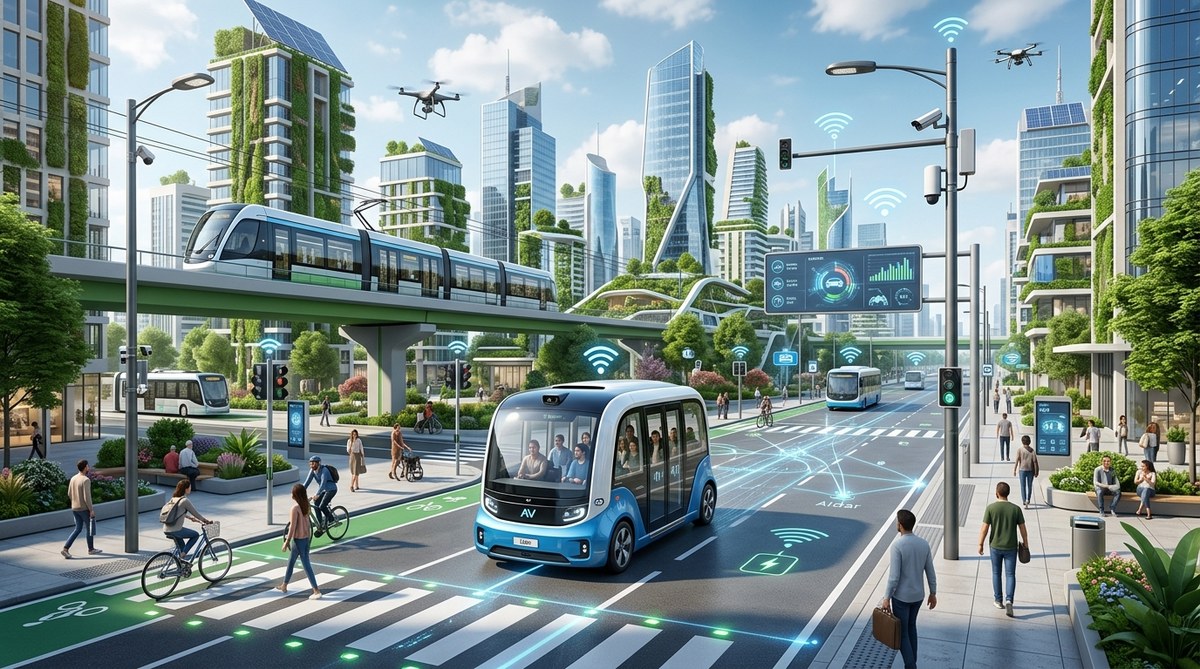
Picture a city where self driving cars glide through intersections without a single traffic light. Pedestrians cross with confidence. Delivery pods find their own parking. It sounds like a scene from a futuristic film, and for good reason. The reality of integrating autonomous vehicles into today’s smart city frameworks is messy, slow, and full of compromises. City technology officers and transportation researchers know this tension well. The hardware exists. The software is getting there. But the urban fabric that these vehicles must weave through was never designed for them. In 2026, the question isn’t whether autonomous vehicles can work. It is whether our cities can handle them.
Autonomous vehicles promise safer roads, less congestion, and greater mobility equity, but integrating them into existing smart city frameworks is far from simple. Urban planners in 2026 face infrastructure gaps, data compatibility issues between systems, and regulatory uncertainty across jurisdictions. This article breaks down the core technical and policy challenges, offers a practical five step roadmap, and shares real world lessons from early adopters to help cities prepare for our autonomous future.
The Gap Between Promise and Pavement
Autonomous vehicle (AV) pilots have been running for years. Atlanta, Phoenix, and San Francisco all host active test zones. Yet none of these cities have achieved full integration with their broader smart city systems. Why? Because the problem is not just about the car. It is about the environment the car operates in.
Smart city frameworks rely on interconnected sensors, traffic management platforms, and real time data sharing. Autonomous vehicles depend on consistent, high fidelity information about road conditions, signage, pedestrian movement, and unexpected obstacles. When those two systems speak different languages, integration stalls.
The core tension comes down to three things: physical infrastructure that was built for human drivers, digital systems that were never designed to talk to moving vehicles, and regulatory frameworks that move at government speed while technology races ahead.
Three Core Integration Challenges
1. Infrastructure Readiness
Most American cities have roads that are decades old. Lane markings fade. Traffic signals use outdated controllers. Construction zones are marked with temporary signs that confuse both humans and machines. For an autonomous vehicle to navigate safely, it needs consistent, predictable infrastructure. That means high contrast lane markings, standardized signage, and digital maps that update in real time.
Few cities have the budget to retrofit every street. Even cities with smart traffic lights often find those lights lack the communication protocols needed to talk to AVs. The result is a patchwork of zones where AVs can operate and zones where they cannot.
2. Data and Communication Standards
Smart city systems generate enormous amounts of data. Air quality sensors, traffic cameras, parking meters, and weather stations all stream information into city dashboards. Autonomous vehicles generate their own data too. But there is no universal standard for how these data streams should connect.
Some cities use proprietary platforms. Others rely on open source solutions. AV manufacturers each have their own data formats and privacy policies. Getting a single vehicle to talk to a city’s traffic management system often requires custom software development for every intersection.
3. Policy and Regulation
No federal framework exists in the United States for AV integration at the city level. The National Highway Traffic Safety Administration (NHTSA) provides voluntary guidance, but each state and municipality sets its own rules. That means a fleet operating in Austin may not be legal in Dallas.
Zoning laws, liability rules, and insurance requirements vary wildly. Some cities require human safety operators in every AV. Others allow fully driverless operations. This inconsistency makes it difficult for cities to plan long term investments in AV compatible infrastructure.
A Practical Roadmap for Urban Planners
If you are a city technology officer or transportation planner wondering where to start, here is a five step process to move from confusion to action.
-
Audit your existing infrastructure layer by layer. Walk every street in your pilot zone. Document lane marking quality, signal controller models, and connectivity gaps. You cannot fix what you have not measured.
-
Adopt open data standards early. Commit to platforms like the Open Mobility Foundation’s Mobility Data Specification (MDS) or the OMA SpecWorks standard. Proprietary systems lock you into single vendor relationships and make future integration harder.
-
Create a dedicated AV communication channel in your traffic management center. This does not have to be expensive. A simple API layer that gives AV operators access to signal phase and timing (SPaT) data can unlock huge safety gains.
-
Run integrated pilots, not isolated tests. Require AV operators to connect to your city’s data platform during pilot programs. Measure latency, data loss, and incident response times together.
-
Update your city’s digital twin to include AV behavior models. A digital twin that simulates traffic with and without autonomous vehicles helps you predict bottlenecks before they happen. For more on this approach, see our piece on are digital twins the key to smarter infrastructure maintenance in 2026.
Common Integration Pitfalls to Avoid
Even well funded cities stumble. Here are the most frequent mistakes urban planners make when trying to integrate AVs into smart city frameworks.
-
Treating AVs as just another vehicle type. Autonomous vehicles behave differently than human driven cars. They stop differently, accelerate differently, and react to obstacles with different timing. Traffic models that treat them as standard vehicles produce inaccurate results.
-
Ignoring cybersecurity from day one. Every connected vehicle is a potential entry point into your city’s network. A compromised AV could be used to disrupt traffic flow, spoof sensor data, or cause collisions. Read more about why why smart city cybersecurity should be a top priority for urban planners in 2026.
-
Overlooking curb management. Autonomous vehicles do not park the same way human drivers do. They may circle while waiting for passengers, drop people in the middle of blocks, or cluster at popular destinations. Cities need new curb use policies to manage this.
-
Focusing only on technology, not on people. Residents need to trust AVs. Without public engagement campaigns and transparent data policies, communities push back against pilots and slow down deployment.
-
Underestimating the maintenance burden. Smart infrastructure requires ongoing upkeep. Sensors fail. Firmware needs updates. Lane markings need repainting. Budget for the long term cost of maintaining AV ready streets.
Comparing Integration Approaches
Different cities are taking different paths toward AV integration. The table below breaks down three common strategies and their tradeoffs.
| Approach | How It Works | Best For | Common Mistake |
|---|---|---|---|
| Dedicated AV lanes | Cities reserve specific lanes for autonomous vehicles only | High density corridors with heavy congestion | Assuming AVs can mix freely with human drivers in the same lane |
| Geo fenced pilot zones | AVs operate only within mapped, sensor rich districts | Testing and data collection before broader rollout | Not planning for how the pilot zone connects to the rest of the city |
| Full digital integration | AVs connect directly to city traffic management via API | Cities with existing smart infrastructure and open data platforms | Ignoring latency and data privacy requirements |
Each approach has merit. The key is matching the strategy to your city’s current maturity level. If your traffic signals still run on copper wiring, start with a geo fenced zone before attempting full digital integration.
Real World Lessons from Early Adopters
Cities that have run AV pilots for three years or more have learned hard lessons about integration. One common theme: the technology works best when the city treats AV operators as partners, not vendors.
“We thought the hardest part would be the software. It was not. The hardest part was getting our own departments to share data. The traffic department had signal data. The public works department had road condition data. The planning department had future construction data. None of it was in one place. Until we fixed that internal data silo, the AVs could not get a complete picture of our streets.” \u2014 Senior Transportation Engineer, City of Arlington, Texas
That lesson matters. Before you can connect AVs to your smart city framework, you have to connect your own departments to each other. Data governance at the city level is a prerequisite, not an afterthought.
Another lesson comes from the curb management front. Cities that deployed AVs without updating curb use policies saw chaos. Ride hail vehicles blocked bike lanes. Delivery bots parked on sidewalks. Pedestrians felt unsafe. The cities that succeeded created new curb zone classifications specifically for AV operations, with time limits, pricing, and enforcement tied to real time demand.
What Cities Should Do Right Now
You do not need a billion dollar budget to start preparing for AV integration. You need a clear eyed assessment of where your city stands today and a phased plan to close the gaps.
Start with a single corridor. Pick one street that has good existing smart infrastructure. Install connectivity upgrades. Run a small scale pilot with a single AV partner. Measure everything. Learn fast. Then scale.
Invest in your data foundation. Your innovative strategies for building smarter urban infrastructure should include a city wide data platform that can ingest, normalize, and share real time sensor data across departments. Without that foundation, AV integration will always be a one off project rather than a systemic capability.
Build relationships with your local AV operators now. Do not wait for a request for proposal. Talk to them about their roadmaps, their data needs, and their pain points. The cities that integrate best are the ones that treat AV companies as collaborators, not contractors.
And finally, keep your residents in the loop. Public trust is fragile. Share your data. Explain your decisions. Listen to concerns. An autonomous vehicle in a hostile city will never succeed, no matter how smart the technology is.
The path from promise to pavement is not straight. But it is walkable. Start small. Collaborate openly. Build the data backbone first. The vehicles will follow.





Leave a Reply