
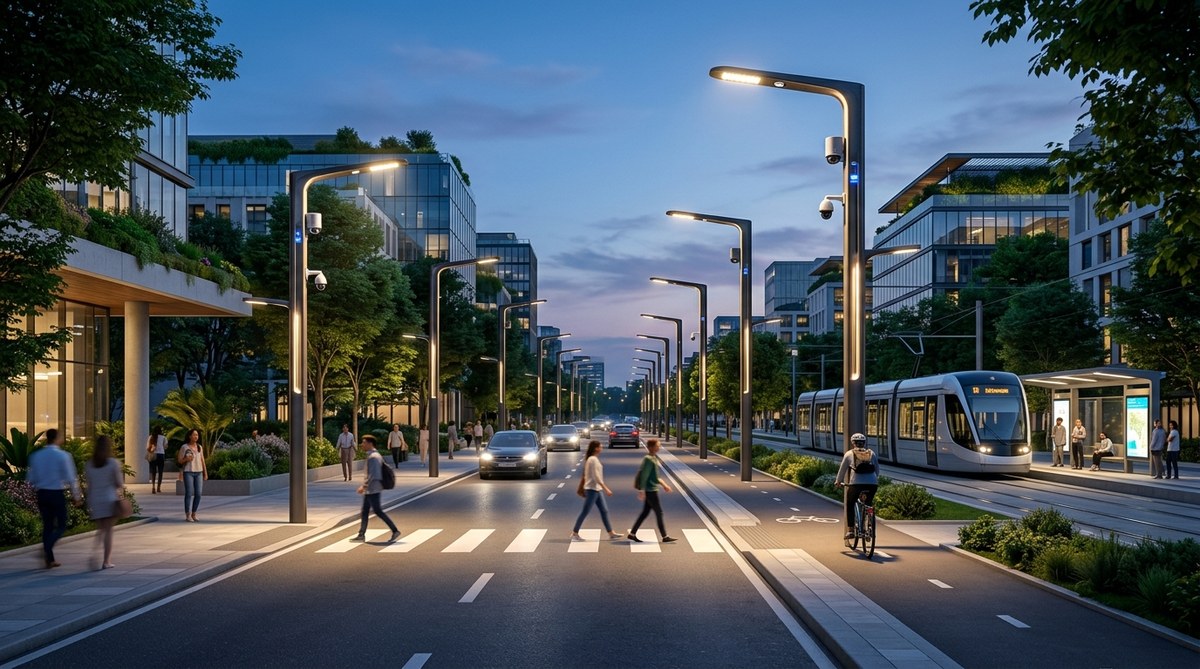
Smart street lighting is one of the most visible upgrades a city can make. It pays for itself in energy savings. It makes roads and sidewalks safer. And it gives city planners a platform for future smart city services. But many municipalities still hesitate because they worry about cost or complexity. The truth is, the technology has matured, and the return on investment is clear. Let’s walk through the real benefits so you can see why so many U.S. cities are upgrading right now.
Smart street lighting cuts energy costs by 50-70% compared to older technologies. It improves public safety through adaptive controls and real-time monitoring. Cities that upgrade see fewer outages, lower maintenance bills, and better community satisfaction. The technology is proven and ready for deployment in 2026.
What Makes a Street Light “Smart”?
A conventional street light runs on a timer or a photocell. It stays at full brightness all night, even when no one is around. A smart street light adds sensors, connectivity, and software. It can dim or brighten based on traffic, pedestrian activity, or ambient light. It reports its own status so crews only visit when a light actually needs repair. And it can serve as a backbone for other sensors, like air quality monitors or traffic counters.
The core components are usually:
– LED luminaires (energy efficient and long lasting)
– Controllers that adjust brightness
– A wireless mesh or cellular network
– Central management software for monitoring and control
Once installed, these lights become a connected asset that pays dividends year after year.
Energy Savings That Fund the Whole Project
The most talked about smart street lighting benefit is energy reduction. LEDs alone cut power use by 50%. When you add adaptive controls, savings climb to 70% or more.
Consider a typical mid-sized city with 10,000 street lights. With older high-pressure sodium fixtures, the annual electricity bill might run $1.2 million. Switching to smart LEDs drops that to around $360,000. That’s a saving of $840,000 per year. In many cases, those savings cover the cost of the new fixtures within three to five years. After that, it’s pure net positive for the general fund.
Some cities go further by negotiating lower rates with their utility for connected lighting. A few even sell demand response services, dimming lights slightly during peak grid load in exchange for rebates. That’s a funding stream that flat lamps cannot offer.
Public Safety Gets a Measurable Lift
Safety is the other side of the coin. Better lighting reduces crashes and crime. Smart lighting makes that effect even stronger.
Adaptive lighting for pedestrians. In areas with heavy foot traffic, lights stay bright until no motion is detected for a set time. Then they dim to a lower level. This saves energy without sacrificing safety. If a person walks down a side street late at night, the lights brighten in front of them and dim behind. It creates a safer corridor and makes people feel more secure.
Evidence from crime studies. Multiple studies in cities like Chicago and New York found that upgraded street lighting correlates with a measurable drop in crime, especially after dark. When lights are uniformly bright and never flicker or go out, criminals lose hiding spots. Public surveillance cameras also work better under even, consistent illumination.
Fewer outages mean safer roads. Failed lamps create dark zones that are dangerous for drivers and pedestrians. Smart lighting tells you the instant a light goes out. Crews can fix it the next day instead of waiting for a citizen complaint. In some cities, response time for outages dropped from weeks to under 48 hours.
Operational Efficiency That Runs Itself
Maintenance is a hidden cost that can eat a city’s budget. Older lights need frequent bulb changes, ballast repairs, and truck rolls. Smart LED fixtures last 50,000 to 100,000 hours, which means 10 to 15 years of service. When a failure happens, the system sends a precise GPS location to a dashboard. No need for night patrols or manual inspections.
The table below sums up the operational differences:
| Activity | Traditional Street Light | Smart Street Light |
|---|---|---|
| Energy cost per year (10,000 lights) | $1,200,000 | $360,000 |
| Lamp life | 12,000 hours (HPS) | 100,000 hours (LED) |
| Replacement frequency | Every 4-5 years | Every 15+ years |
| Outage detection | Manual report or patrol | Automatic alert within minutes |
| Dimming capability | None | Remote, per fixture |
| Additional sensor support | None | Yes (air quality, traffic, noise) |
Cities that switch often redeploy maintenance staff to higher value projects. One city in Texas said it freed up three full time electricians who now work on park lighting and traffic signals instead.
How to Plan a Smart Street Lighting Project: a Numbered Process
If you’re convinced of the smart street lighting benefits, here’s a practical sequence to follow:
- Audit your existing inventory. Count every pole, note the fixture type, and map their locations.
- Set your goals. Is the priority energy savings, safety, or both? Define measurable targets.
- Choose a communication network. Wi-fi, cellular, or mesh? Consider existing city IT infrastructure.
- Select fixtures and controls. Look for L70 rated LEDs (70% light output at 100,000 hours) and open standard controllers like Zhaga or TALQ.
- Write a performance based contract. Consider an Energy Service Agreement (ESA) where the vendor guarantees savings.
- Pilot on a small district. Test for three months and analyze data before full deployment.
- Scale citywide with continuous monitoring. Use the central management software to track performance and adjust schedules.
A Quick Look at the Main Benefits
- 50-70% reduction in energy use
- Lower carbon emissions (supports sustainability goals)
- Reduced maintenance costs
- Adaptive lighting for safer streets
- Fewer dark zones and outages
- Data driven insights for future planning
- Integration with other smart city systems
Real Advice from a City Engineer
“We were nervous about investing in smart lighting. But after a 500-light pilot, the data was undeniable. Our energy bill dropped 60%, and nighttime collisions on that corridor fell by 23%. Now we’re rolling out citywide. The hardest part was picking the right partner, not the technology.” – Aaron M., Senior Engineer, City of Greenville
That kind of outcome is repeatable. The key is to start with a clear pilot and build a case that your city council can support.
What’s Next for Smart Lighting in 2026 and Beyond
The technology is not standing still. Newer systems use LiDAR and edge computing to track traffic patterns in real time. Some cities are adding gunshot detection to the same lighting poles. Others are using the network to monitor weather and adjust lighting for fog or rain.
Smart street lighting fits naturally into broader urban infrastructure plans. For example, the data you collect from lights can support innovative strategies for building smarter urban infrastructure. Your lighting network can also serve as a platform for implementing smart technologies for efficient urban planning. And when you combine lighting with renewable energy microgrids, you move toward the future of green urban development.
Your Next Step Toward Smarter Infrastructure
Smart street lighting is no longer a pilot project for early adopters. It’s a proven, cost effective upgrade that delivers real savings and safer communities. The best time to act was last year. The second best time is now. Start with an inventory, talk to a few vendors, and run a small pilot. Your city’s budget and your residents will thank you.


Leave a Reply