
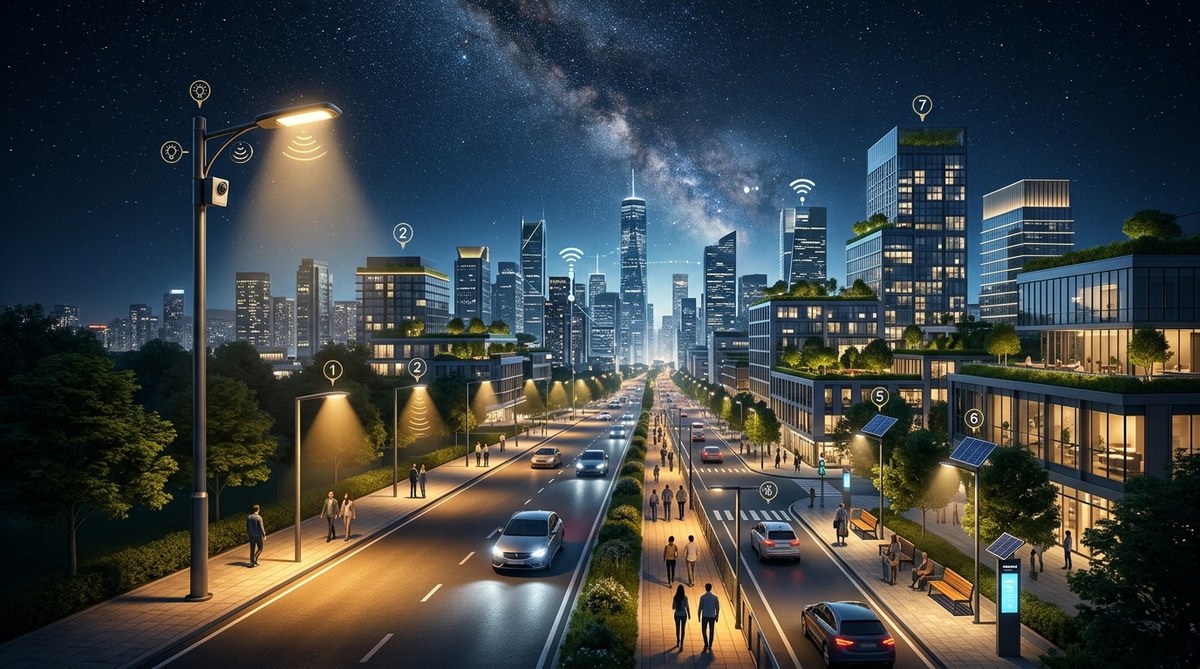
Cities have always been places of light. But for decades, that light has come at a cost. Skyglow, glare, and light trespass have erased the Milky Way for more than 80 percent of North Americans. It disrupts wildlife migration, throws off human circadian rhythms, and wastes billions of dollars in electricity every year. The good news is that 2026 is shaping up to be a turning point. New smart city lighting innovations are finally making it possible to keep streets safe and vibrant without flooding the night sky with wasted photons. Urban planners and sustainability officers now have a toolkit that actually works.
Seven smart city lighting innovations are actively reducing light pollution in 2026. Adaptive LED systems, full-cutoff fixtures, tunable white light, IoT sensor networks, wildlife-friendly color spectrums, smart dimming zones, and centralized control platforms all work together to cut glare and skyglow. Municipalities using these technologies report energy savings of 40 to 60 percent alongside measurable improvements in nighttime darkness quality.
Why Light Pollution Demands New Thinking
Traditional streetlights scatter light in every direction. A typical cobra-head fixture from the 1990s sends as much as 30 percent of its light upward into the sky. That light does nothing for safety on the ground. It just creates an orange glow that hides the stars. Worse, it confuses nocturnal animals. Sea turtle hatchlings crawl toward bright beachfront lights instead of the ocean. Migrating birds circle glowing cities until they collapse from exhaustion.
The shift to LED lighting a decade ago helped lower energy use, but early LEDs often made light pollution worse. They emitted harsh blue-rich light that scattered more easily in the atmosphere. Many municipalities simply swapped bulbs without changing fixtures or controls. The result was a brighter, bluer, more intrusive nightscape.
2026 is different. The latest generation of smart city lighting is designed from the ground up to put light only where it is needed, only when it is needed, and only at the color temperature that minimizes environmental harm.
The Seven Innovations That Are Making a Difference
Here are the specific technologies and approaches that are reshaping how cities light their streets, parks, and public spaces.
1. Full-Cutoff and Dark-Sky Compliant Fixtures
The first and most fundamental change is in the hardware itself. Full-cutoff fixtures use precision optics to direct all light downward. There is no upward light emission. Zero glare above the horizontal plane.
Cities like Tucson, Arizona, and Flagstaff have been leaders here for years. They proved that you can have well-lit streets and still see the Andromeda Galaxy. In 2026, full-cutoff designs are no longer a specialty product. They are the default specification for most major lighting manufacturers. The cost premium over older designs has nearly disappeared.
2. Adaptive Dimming with Real-Time Sensors
A street that needs full illumination at 8 PM during a busy shopping evening does not need the same light level at 3 AM on a Tuesday. Adaptive dimming uses motion sensors, ambient light sensors, and even traffic counters to adjust brightness in real time.
A typical system works like this:
- The sensor detects no movement for a set period (usually five to ten minutes).
- The controller dims the light to a preset minimum level (often 20 to 30 percent of full output).
- When a pedestrian, cyclist, or vehicle approaches, the light ramps up to full brightness within seconds.
- The system logs each dimming event for energy reporting and maintenance alerts.
Cities using adaptive dimming report energy reductions of 50 percent or more. Just as important, the lower light levels during quiet hours dramatically reduce skyglow. The light that is still on is carefully aimed downward, so it does not contribute to light pollution in the same way a constant full-blast fixture does.
3. Tunable White Light and Circadian-Friendly Color Spectrums
The color of light matters enormously for light pollution. Blue-rich white light scatters more in the atmosphere, creating a larger skyglow footprint. It also suppresses melatonin production in humans and disrupts wildlife.
New tunable white LED systems allow cities to shift color temperature throughout the night. A typical schedule might use a warmer 2700K light during late-night hours and a slightly cooler 3000K light during peak evening activity. The warmest setting produces an amber-like glow that has minimal impact on both skyglow and wildlife.
Some systems go further with narrow-band amber LEDs that emit only in a very tight wavelength range around 590 nanometers. These lights are nearly invisible to many insects and sea turtles while still providing adequate illumination for human vision. They are becoming the standard in coastal communities and nature preserves.
4. IoT-Connected Centralized Control Platforms
Individual smart fixtures are useful, but the real power comes from connecting them all into a single management platform. An IoT-based lighting control system gives urban planners a dashboard view of every streetlight in the city.
From that dashboard, operators can:
- Adjust dimming schedules for an entire neighborhood in seconds.
- Create custom zones for different land uses (downtown, residential, industrial, park).
- Receive automatic alerts when a fixture needs maintenance.
- Monitor energy consumption per fixture, per zone, or citywide.
- Override settings for special events or emergency situations.
The centralized approach also makes it easier to enforce light pollution reduction policies. If a certain district needs to meet a specific brightness cap, the system can enforce that limit automatically.
5. Wildlife-Friendly Lighting Corridors
Light pollution fragments habitats. Nocturnal animals avoid brightly lit areas, which can cut their foraging and migration routes in half. Smart cities in 2026 are addressing this with wildlife-friendly lighting corridors.
These corridors use a combination of the innovations already mentioned: full-cutoff fixtures, warm color spectrums, and adaptive dimming. The key difference is that they are planned as networks. A corridor might connect two natural areas through a developed zone, with every light along the path set to the same wildlife-safe parameters.
Some cities are also using sensor-triggered lights that stay completely off until an animal passes through. Infrared cameras detect the movement and briefly illuminate the crossing for safety, then go dark again.
6. Smart Zoning and Time-Based Restrictions
Not every street needs to be lit all night. Smart zoning divides a city into lighting districts with different rules. A busy commercial corridor might have lights at 100 percent until midnight, then dim to 40 percent until dawn. A quiet residential street might stay at 30 percent all night with motion-activated boosts.
Time-based restrictions go a step further. Some cities have adopted “lights out” periods in certain zones. During those hours, the only light comes from motion-activated fixtures. This approach works well in parks, greenways, and low-traffic residential areas.
The table below compares traditional lighting with the smart zoning approach:
| Feature | Traditional Lighting | Smart Zoning (2026) |
|---|---|---|
| Brightness level | Fixed 100 percent all night | Variable by zone and time |
| Color temperature | Fixed (often 4000K or higher) | Tunable (2700K to 3000K) |
| Light direction | Upward scatter common | Full-cutoff, zero uplight |
| Control method | Timer or photocell only | IoT platform with sensors |
| Energy waste | High (constant full power) | Low (dimmed when empty) |
| Light pollution impact | Significant skyglow | Minimal to none |
7. Public Engagement and Feedback Loops
The final innovation is not a piece of hardware. It is a process. Smart cities in 2026 are involving residents in lighting decisions through feedback platforms. People can report a light that is too bright, too dim, or misdirected using a mobile app. The city responds by adjusting that specific fixture through the central control system.
This closes the loop between community needs and environmental goals. A resident who wants a brighter sidewalk for safety can get it without the city having to raise the light level on an entire block. The system allows for granular adjustments that balance safety, comfort, and dark-sky preservation.
“The most successful light pollution reduction programs are the ones that give residents a voice. When people understand that they can have both safety and a dark sky, they become the strongest advocates for smart lighting.” – Dr. Elena Marchetti, urban lighting researcher at the University of Colorado Boulder.
A Practical Process for Implementing Smart Lighting
If you are a municipal sustainability officer or urban planner looking to reduce light pollution in your city, here is a step-by-step process that works in 2026.
-
Audit your existing inventory. Walk every street and catalog every fixture. Note the type, wattage, color temperature, and condition. This gives you a baseline.
-
Set measurable targets. Decide how much you want to reduce skyglow. A common goal is a 50 percent reduction in upward light emission within three years.
-
Prioritize high-impact zones. Start with areas near parks, waterfronts, and nature reserves. These zones benefit most from wildlife-friendly lighting.
-
Specify full-cutoff fixtures. Make this a non-negotiable requirement in your procurement documents.
-
Choose a control platform. Look for systems that support tunable white light, adaptive dimming, and open APIs for future integration.
-
Run a pilot program. Test the system in one neighborhood for at least three months. Measure energy use, resident satisfaction, and sky brightness before and after.
-
Scale and monitor. Roll out the system citywide. Use the data from the control platform to continuously fine-tune schedules and dimming levels.
Common Mistakes to Avoid
Even the best technology can fail if it is implemented poorly. Here are the most common pitfalls that undermine light pollution reduction efforts.
- Overlighting intersections. Many cities install lights that are far brighter than needed at crosswalks and intersections. Use lower wattage fixtures with precise optics.
- Ignoring color temperature. A 4000K light may save energy compared to older technology, but it still produces significant skyglow. Stick to 2700K or 3000K.
- Skipping community outreach. Residents may resist dimming if they think it means less safety. Explain the technology and show data from successful pilots.
- Buying proprietary systems. Some lighting control platforms lock you into a single vendor. Choose open standards that allow future upgrades.
Looking Ahead: The Next Steps for Urban Lighting
The innovations described here are already deployed in cities from Los Angeles to Barcelona to Melbourne. In 2026, the conversation is shifting from “should we adopt smart lighting?” to “how fast can we retrofit?” The technology is mature. The costs are competitive. The environmental benefits are clear.
For urban planners and sustainability officers, the opportunity is huge. Every streetlight that gets upgraded to a smart, full-cutoff, adaptive fixture is a step toward reclaiming the night sky. It is also a step toward more efficient operations, lower carbon emissions, and healthier ecosystems.
The tools exist. The case studies are compelling. The only question left is when your city will start.
Bringing the Night Sky Back into View
The goal of smart city lighting is not to make the city dark. It is to make the light intelligent. When every photon is aimed, timed, and colored with purpose, the city stays safe and vibrant while the stars come back into view. That is the promise of the innovations we have covered here. It is a promise that cities across the United States are already delivering on in 2026. If you are planning a lighting retrofit or a new development, the technology is ready. The dark sky is waiting.




Leave a Reply