
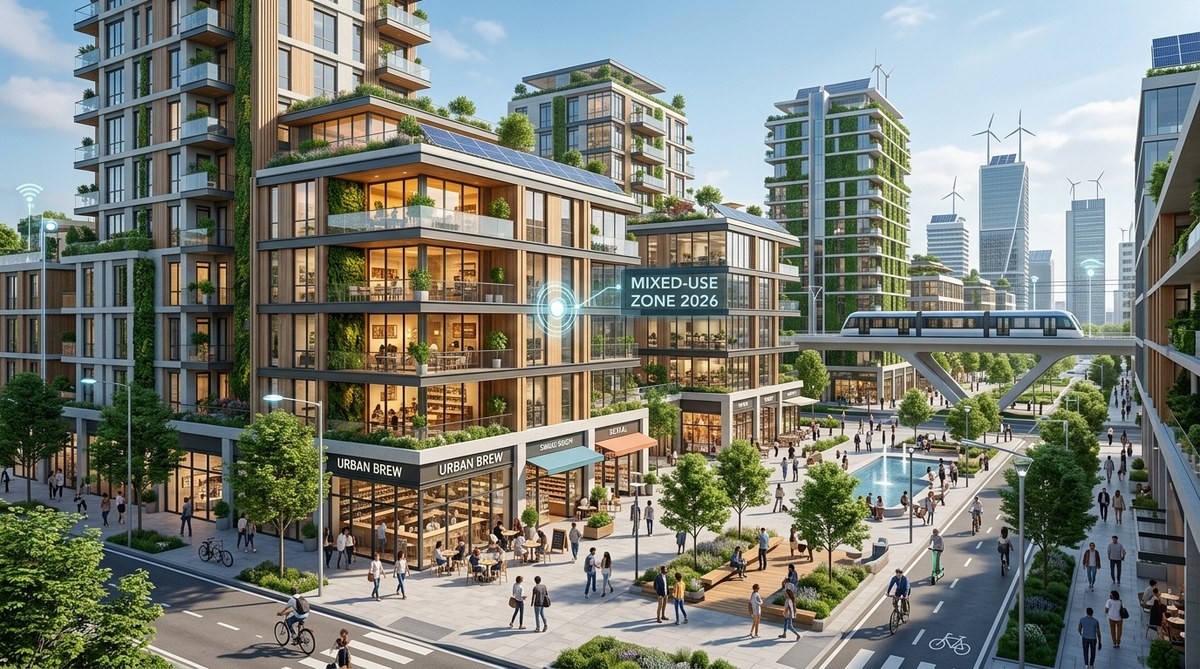
Smart zoning laws are rewriting the rules of urban development by blending housing, retail, and public space in single projects. For 2026, these policies reduce parking minimums, encourage transit-oriented density, and streamline approvals. This article explains how planners and developers can use these reforms to build vibrant, walkable neighborhoods while avoiding common pitfalls and securing community support.
Why Smart Zoning Laws Matter Now
For decades, American cities separated homes from shops, offices from parks, and schools from everything else. This approach, known as Euclidean zoning, shaped the suburbs and the car dependent landscapes we know today. But the tide has turned. Across the United States, a growing number of cities are rewriting their land use codes to embrace mixed-use development. The catalyst? Smart zoning laws that prioritize people over parking lots and flexibility over rigid separation.
These modern regulations are not just about allowing apartments above bakeries. They are reshaping how we think about density, transit, affordability, and community character. For urban planners, real estate developers, and local government officials, understanding how these laws work is no longer optional. It is essential.
Mixed-use development has become the centerpiece of many city housing strategies. And smart zoning laws are the tool making it possible.
Smart zoning laws are reshaping American cities by allowing residential, commercial, and civic uses to share the same block. This article explores how modern reforms such as form based codes, density bonuses, and transit oriented overlays unlock mixed-use development, with practical steps, policy examples, and expert advice for planners and developers.
Why Smart Zoning Laws Are the Backbone of Mixed-Use Development
For decades, the American city was a puzzle with strictly separated pieces. Single-family homes sat apart from shops, which sat apart from offices. Then came the drive to rethink how we build communities, and zoning laws had to catch up. Smart zoning laws are now the quiet engine behind mixed-use development, allowing people to live, work, shop, and play in the same neighborhood without getting into a car.
Mixed-use development is not a new idea. But modern smart zoning laws are making it easier to build these projects in 2026. These laws remove outdated barriers, encourage density around transit, and create more walkable, human-centered neighborhoods. For planners, developers, and local officials, understanding these policies is essential to shaping cities that are both livable and resilient.
This article explores how smart zoning laws are unlocking mixed-use development in 2026. It covers real world examples, practical steps for implementation, common mistakes to avoid, and what the future holds for flexible urban policy.
Smart zoning laws are reshaping American cities by blending housing, retail, and workspaces into walkable neighborhoods. This article explains how form-based codes, density bonuses, and transit-oriented overlays help developers cut risk and speed up approvals. You will learn policy models, practical implementation steps, common pitfalls, and future trends shaping mixed-use development in 2026 and beyond.
What Are Smart Zoning Laws and Why Do They Matter?
Zoning has long been a quiet force shaping American life. For decades, single-use districts kept homes, stores, and offices separated. That model created sprawling commutes and car dependent neighborhoods. In 2026, a growing number of cities are rewriting those rules. Smart zoning laws are the new toolkit for building places where people can live, work, shop, and play within a short walk. They are not just about changing what is allowed. They are about changing how we think about the very fabric of urban life.
Smart zoning laws mixed-use development is the exact phrase planners and developers are searching for as they navigate this shift. These laws move beyond rigid land use separation and instead prioritize flexibility, density, and human-scale design. The result is a more resilient, livable, and economically diverse city. And the best part? The tools to make it happen are already available. You just need to know how to use them.
Smart zoning laws are rewriting how cities grow by blending homes, shops, and workspaces into walkable districts. These reforms cut sprawl, ease housing costs, and boost transit use. Success depends on clear policy design, community buy-in, and adaptive rules that keep pace with real-world development needs.
What Exactly Are Smart Zoning Laws?
Zoning laws are the rulebook for what can be built where. Traditional zoning separates uses. Homes here, shops there, offices somewhere else. Smart zoning flips that script. It allows compatible uses to mix naturally within the same building or neighborhood. Think ground-floor cafes under apartments, or live-work lofts above boutiques.
Smart zoning laws are not about throwing out the rulebook. They are about rewriting it with intention. These laws use flexible tools like density bonuses, inclusionary zoning, and transit-oriented overlays. They respond to what a community actually needs rather than what a static map says. That is why smart zoning laws mixed-use development has become such a hot topic in planning departments across the country.
The goal is simple. Create neighborhoods where people can live, work, shop, and play without needing a car for every errand. That means more housing options, more foot traffic, and more vibrant streets. It also means less sprawl and lower infrastructure costs. For cities wrestling with affordability and climate goals, that is a powerful combination.
Why Mixed-Use Development Matters Right Now
Mixed-use development is not a new idea. Historic downtowns did this for centuries. But post-war zoning laws pushed uses apart, and we are still feeling the consequences. Sprawling subdivisions, empty office parks, and miles of single-use streets have left many cities with long commutes and isolated neighborhoods.
Smart zoning laws mixed-use development is the corrective lens. By allowing more density and a mix of uses, cities can accommodate growth without expanding outward. This is especially important in regions facing serious housing shortages. When zoning permits apartments above shops or duplexes in single-family zones, the supply of homes increases. And with more supply, prices become more manageable.
There is also a sustainability angle. Walkable neighborhoods reduce vehicle miles traveled. Fewer car trips mean lower emissions. They also support public transit, because ridership thrives in compact, mixed areas. Planners are realizing that the land-use rules we write today determine the carbon footprint of tomorrow.
How Smart Zoning Laws Support Housing Affordability
Housing affordability is the defining challenge of our era. In many cities, the price of entry is simply out of reach for teachers, nurses, and retail workers. Smart zoning laws tackle this by unlocking the missing middle. That includes accessory dwelling units, duplexes, fourplexes, and small apartment buildings.
One of the most effective tools is the density bonus. This allows developers to build more units than the base zoning permits, provided they include a share of income-restricted homes. Another tool is inclusionary zoning, which sets aside a percentage of units as affordable. Both approaches rely on a smart zoning framework to work.
Smart zoning also reduces regulatory friction. When the rules are clear and predictable, projects move faster. Faster approvals mean lower carrying costs for developers. Those savings can be passed on to renters and buyers. That is a win-win that only works when the zoning code is designed with flexibility in mind.
Transit-Oriented Development and Zoning Reform
If you have ever stood on a train platform surrounded by parking lots, you know the problem. Transit stations are often islands in a sea of asphalt. Smart zoning laws mixed-use development changes that by creating transit-oriented development zones. These are areas within a short walk of a station where higher density and mixed uses are allowed by right.
This approach has been gaining traction in places like Salt Lake City, where recent zoning changes created transit station area zones. These zones make it easier to build apartments, offices, and retail near rail lines. The result is more riders, fewer cars, and a better return on transit investment.
But it is not just about density. It is about the right kind of density. A successful transit zone includes a range of housing types, safe pedestrian routes, and ground-floor uses that activate the street. That requires a smart zoning framework that goes beyond just increasing height limits.
The Role of Community Engagement in Zoning Reform
No zoning law survives contact with the community unless people feel heard. Smart zoning laws are not just technical documents. They are expressions of community values. That is why the best reform efforts start with robust public engagement.
Planners need to listen before they write. What do residents want to see? What are they worried about? Traffic? Parking? Change in character? Addressing these concerns head-on builds trust and reduces friction down the line. Community engagement is not a box to check. It is the foundation of lasting reform.
One effective approach is the use of design guidelines. These give developers clear expectations about scale, materials, and street presence. When done well, they reassure neighbors that new development will fit the existing context. That is how smart zoning laws mixed-use development gains political staying power.
Common Mistakes in Zoning Reform Efforts
Reforming zoning is hard work, and many cities stumble. The most common mistake is going too far too fast. Sweeping changes can trigger backlash that stalls the whole effort. Another mistake is doing it all at once without a clear implementation plan. Rules on paper do not matter if they are not backed by processes and resources.
Here is a quick look at some common missteps and how to avoid them:
| Mistake | Why It Happens | How to Fix It |
|---|---|---|
| Overriding local input | Planners act unilaterally | Use co-design workshops early |
| Ignoring parking reform | Car-centric assumptions remain | Adopt flexible parking standards |
| One-size-fits-all rules | No attention to context | Use district-specific overlays |
| Weak design standards | Fear of limiting developers | Use form-based codes |
| No affordability mandate | Market alone fails | Pair upzoning with inclusionary rules |
Avoiding these pitfalls requires patience and political skill. But the payoff is worth it. A well-crafted zoning code can guide growth for decades.
A Step-by-Step Process for Adopting Smart Zoning Laws
If your community is ready to embrace smart zoning laws mixed-use development, here is a practical path forward:
- Audit your current code. Identify where the code blocks mixed-use or density. Map the barriers.
- Set clear goals. Define what you want to achieve. More housing? Less car use? More small business?
- Engage the community. Hold workshops, surveys, and open houses. Listen to concerns and aspirations.
- Draft the new rules. Write flexible, use-based standards. Include density bonuses and design guidelines.
- Run a fiscal and environmental review. Show the benefits. Make the case with data.
- Adopt and implement. Pass the ordinance through council. Allocate staff and resources for enforcement.
- Monitor and adjust. Track outcomes. Amend the code as needed. Zoning is never a one-and-done exercise.
This process works best when it is iterative. No one drafts a perfect code on the first try. The key is to start, learn, and refine.
Innovative Strategies for Building Smarter Urban Infrastructure
Smart zoning does not exist in a vacuum. It works hand in hand with infrastructure. That is why forward-looking cities are pairing zoning reform with investments in complete streets, stormwater management, and district energy systems. The goal is to create places that are not just dense, but also durable and delightful.
Innovative Strategies for Building Smarter Urban Infrastructure
The Future of Green Urban Development: Trends and Technologies to Watch
As zoning reform matures, it is converging with green building practices. Solar-ready roofs, green walls, and electric vehicle charging are becoming standard in new mixed-use projects. These features are easier to deliver when the zoning code rewards sustainable design. That is where the future of green urban development comes in.
The Future of Green Urban Development: Trends and Technologies to Watch
Expert Advice on Making Zoning Reform Stick
“The secret to successful zoning reform is to make it boring. The best codes are the ones that feel inevitable. They do not shock anyone. They simply allow good things to happen by right. When the rules are clear and predictable, the market responds. That is how you get mixed-use development without a fight.” — Maria Delgado, Senior Planner
That insight rings true. Zoning is not glamorous, but it is powerful. When it is done well, it quietly shapes the city for a generation. When it is done poorly, it creates problems that take decades to undo.
Conclusion: The Time to Act Is Now
Smart zoning laws mixed-use development is not a passing trend. It is a necessary evolution. Cities across the country are facing a perfect storm of housing shortages, climate pressures, and shifting preferences. People want walkable neighborhoods. They want housing options. They want to live in places worth caring about.
Smart zoning laws are the tool that can get us there. They are flexible, evidence-based, and responsive to community needs. They do not force change. They simply allow it. And in a world that is changing fast, that flexibility is everything.
Whether you are a planner, an elected official, or a resident, the message is the same. Start the conversation. Audit your code. Engage your neighbors. The future of your city may depend on it.










Leave a Reply