
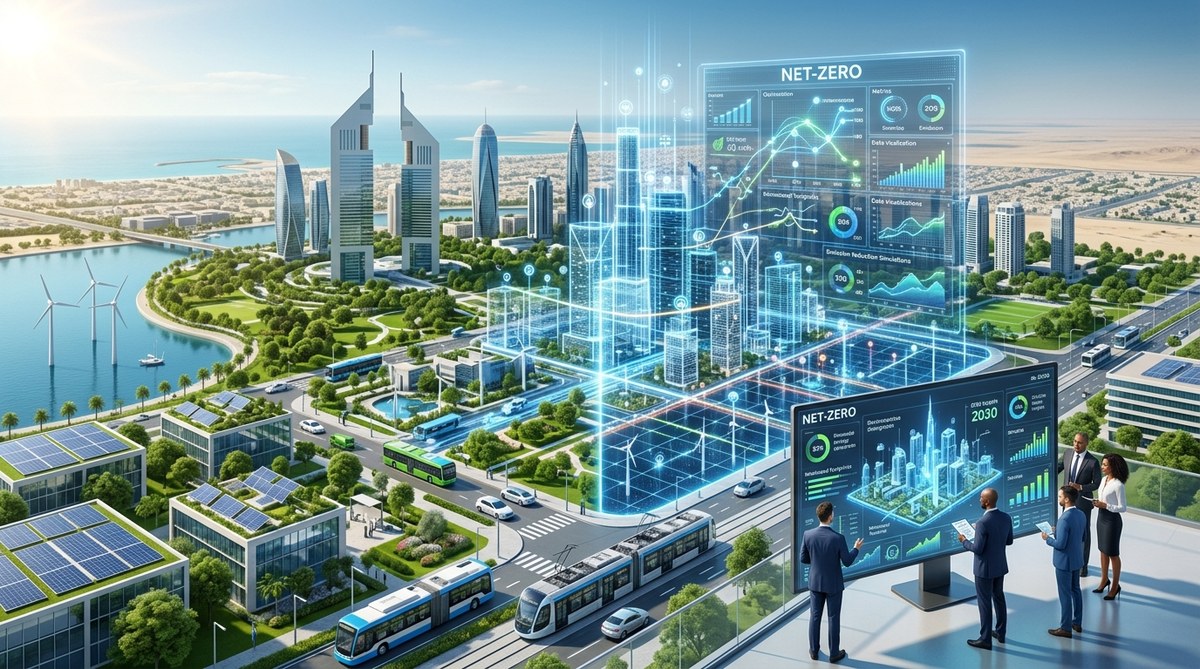
Cities are responsible for more than 70% of global carbon emissions. That statistic alone explains why urban planners and sustainability officers are under immense pressure to meet ambitious climate targets. The year 2030 is no longer a distant milestone; it is a deadline that feels uncomfortably close. One technology that keeps coming up in strategy meetings and policy documents is the urban digital twin. The promise sounds almost too good to be true: a virtual replica of an entire city that can simulate, predict, and optimize every system from energy grids to traffic patterns. But can these digital mirrors actually help cities achieve net zero emissions by 2030? Let’s look at the evidence, the limits, and the practical path forward.
Urban digital twins are not a silver bullet, but they are a powerful accelerant. When paired with real-time sensor data and strong governance, they can cut building energy use by 30% and optimize district heating networks. The catch is that most cities lack the data foundation and institutional will to deploy them at scale before 2030.
What an urban digital twin actually does
An urban digital twin is more than a 3D model of a city. It is a living system that ingests data from Internet of Things sensors, weather stations, utility meters, and traffic cameras. It updates in near real time. Planners can run simulations to see what happens if they add a new bus lane, change building codes, or install solar panels on every public roof.
Think of it as a flight simulator for a city. Pilots train on simulators before flying a real plane because mistakes in the air are costly. The same logic applies to urban planning. You can test a policy in the digital twin before spending millions of dollars on implementation. This is especially valuable for net zero strategies because the margin for error is so small.
Where digital twins can move the needle on emissions
The most immediate impact of urban digital twins comes from optimizing existing infrastructure. Retrofitting an entire city is expensive and slow. Digital twins help you get more performance out of what you already have.
Energy performance in buildings
Buildings account for roughly 40% of urban emissions. A digital twin connected to smart meters and HVAC sensors can identify exactly which buildings are wasting energy. Some cities have used this approach to reduce heating and cooling loads by 20% to 30% without any physical upgrades. The twin finds patterns in occupancy, weather, and equipment performance that human operators miss.
District heating and cooling networks
District energy systems are complex. They involve multiple generation sources, storage tanks, and distribution pipes. A digital twin can balance supply and demand across the network in real time. It can predict when demand will spike and pre-cool or pre-heat the system using renewable sources. This reduces reliance on backup natural gas boilers.
Transportation optimization
Traffic congestion is not just an annoyance. It is a major source of emissions. Digital twins can simulate the impact of congestion pricing, bus priority lanes, and bike infrastructure before construction begins. Some cities have used them to redesign traffic signal timing, cutting idling time by 15% and reducing fuel consumption.
The hard truth about 2030
Here is where the conversation gets honest. The 2030 deadline is only a few years away. Most cities are not ready to deploy a full-scale urban digital twin. The technology exists, but the prerequisites do not.
A functional digital twin requires:
– A dense network of IoT sensors that are calibrated and maintained
– Data integration across dozens of city departments that do not share information
– Computing infrastructure capable of processing terabytes of data
– Skilled staff who can interpret simulations and translate them into policy
– Governance frameworks that protect privacy and ensure equitable outcomes
Very few cities have all five of these in place. The cities that are furthest along, like Singapore, Helsinki, and New York, started building their digital twins years ago. For a city starting from scratch today, a comprehensive twin that covers the entire urban footprint is unlikely to be operational before 2028 at the earliest. That leaves only two years to act on the insights.
A practical process for getting started
If you are an urban planner or sustainability officer evaluating this technology, do not wait for a perfect system. Start with a focused twin that targets your highest emission source.
- Identify your biggest emission lever. Is it buildings? Transportation? Waste? Pick one sector where you have existing data and a clear policy mandate.
- Build a minimum viable twin for that sector. Use existing data from utility bills, traffic counts, and satellite imagery. You do not need real-time sensors on day one.
- Validate the model against real outcomes. Run a simulation and compare it to actual measurements. Adjust until the model is accurate within 10%.
- Run scenario tests with stakeholders. Show policymakers and community groups what different choices mean for emissions, cost, and equity.
- Iterate and expand. Once the sector twin is trusted, add more data sources and expand to other sectors.
Common mistakes cities make
| Mistake | Why it hurts | Better approach |
|---|---|---|
| Buying a flashy 3D visualization without data integration | Looks impressive but provides no actionable insight | Start with a data model, not a visual model |
| Trying to model the entire city at once | Overwhelms the team and delays results | Focus on one high-impact sector first |
| Ignoring data quality | Garbage in, garbage out. Bad data leads to bad simulations | Invest in sensor calibration and data cleaning |
| Keeping the twin in the IT department | Planners and policy teams never use it | Train cross-functional teams to run simulations |
| Forgetting about maintenance | A twin that is not updated becomes useless | Budget for ongoing data collection and model updates |
“The most successful urban digital twin projects are not the ones with the most advanced technology. They are the ones where the city government is willing to change how it makes decisions.” From a 2025 interview with the chief digital officer of a European capital city.
What the research says about feasibility
Academic studies on urban digital twins for net zero are still emerging, but the early results are encouraging. A 2025 paper from the Journal of Urban Technology found that cities using digital twins for energy management reduced their building sector emissions by an average of 18% over three years. Another study from the Smart Cities Research Institute showed that digital twins were most effective when combined with a carbon pricing mechanism.
The research also highlights limits. Digital twins cannot fix policy failures. If a city lacks the political will to enforce building codes or invest in public transit, the twin becomes an expensive toy. Technology is a tool, not a substitute for leadership.
How to evaluate whether a digital twin is right for your city
Before you invest millions in a digital twin platform, ask these questions:
- Do we have reliable data on our biggest emission sources?
- Are our city departments willing to share data with each other?
- Do we have staff who can run simulations and communicate results?
- Is there a clear policy question we want the twin to answer?
- Do we have a budget for ongoing maintenance and updates?
If you answered no to two or more of these, focus on building the foundation first. You can start by improving your data collection and breaking down silos between departments. For a deeper look at the foundational technologies, read our guide on harnessing data analytics to transform urban living in smart cities.
The role of digital twins alongside other net zero strategies
Digital twins are not a replacement for other sustainability measures. They work best when layered on top of existing initiatives. Consider them a coordination layer that helps you get the most out of your investments in renewable energy, efficient buildings, and green infrastructure.
For example, if your city is installing solar panels on public buildings, a digital twin can tell you exactly where to place them for maximum generation. If you are building a network of electric vehicle charging stations, the twin can model where demand will be highest. If you are implementing green roofs to reduce stormwater runoff, the twin can simulate the cooling effect on the surrounding neighborhood.
This kind of integration is what makes digital twins valuable. They help you see the connections between systems that are usually managed in isolation. For more on how these pieces fit together, check out our piece on integrating renewable energy microgrids into smart city planning.
A realistic look at the 2030 timeline
Let us be direct. A city that starts building a comprehensive urban digital twin today will not have a fully operational system until 2028 or 2029. That leaves very little time to implement the changes the twin recommends. Construction projects take years. Retrofitting a building stock takes a decade. Changing land use patterns takes even longer.
This does not mean digital twins are useless for 2030. It means you need to focus on interventions that can be deployed quickly. The most effective near-term uses are:
- Adjusting traffic signal timing to reduce congestion
- Optimizing district heating and cooling setpoints
- Identifying the worst performing buildings for targeted retrofits
- Informing time-of-use electricity pricing to shift demand
These are low-cost, high-impact changes that a digital twin can identify and validate within months. They will not get you all the way to net zero, but they can deliver 10% to 20% emission reductions by 2030. That is meaningful progress.
Building the case for investment
If you need to convince your city council or budget committee to fund a digital twin initiative, focus on the return on investment. The upfront cost is significant, but the savings from energy optimization alone often pay back within two to three years. Add in avoided infrastructure costs from better planning, and the business case becomes strong.
Use examples from cities that have already done it. Singapore’s virtual Singapore project saved an estimated $100 million in infrastructure costs during its first five years. Helsinki’s energy twin reduced heating costs by 15% across the city’s district heating network. These are not hypothetical benefits. They are real outcomes.
For a broader look at how smart technologies are reshaping city budgets, see our article on 7 smart city technologies that will dominate urban development in 2026.
What the next few years look like
The technology is improving rapidly. Artificial intelligence models are getting better at predicting building energy use. Sensor costs are dropping. Cloud computing is becoming more affordable. The barriers that exist today will be lower in 2027 and 2028.
The wildcard is institutional readiness. Cities that invest now in data infrastructure, cross-departmental collaboration, and staff training will be ready to take advantage of these improvements. Cities that wait will fall further behind.
The cities that hit 2030 with a functioning digital twin will not be the ones with the biggest technology budget. They will be the ones that started small, learned fast, and built the organizational muscle to use data in decision making.
Your next steps
If you are serious about using urban digital twins to reach net zero, start today. Not with a procurement process. Not with a vendor pitch. Start with a conversation between your sustainability team, your IT department, and your transportation department. Ask them one question: “What is the biggest emission problem we could solve together if we shared our data?”
That conversation will tell you more about your city’s readiness than any technology assessment. If it goes well, you have a path forward. If it does not, you know where the real work needs to happen.
For more on building the community and political support these projects need, read 6 smart city policies that are redefining urban resilience in 2026.
Digital twins are a tool, not a miracle
Urban digital twins can help cities achieve net zero emissions. The evidence from early adopters is clear. They reduce energy waste, optimize complex systems, and help planners make better decisions with limited resources. But they cannot bend the laws of physics or politics. A digital twin will not fix a broken procurement process. It will not replace the need for strong building codes. It will not make residents accept higher density housing overnight.
What it can do is give you clarity. It can show you which interventions will have the biggest impact. It can help you avoid costly mistakes. It can build consensus by letting stakeholders see the consequences of their choices before they are locked in.
The question is not whether urban digital twins can help cities achieve net zero emissions by 2030. The question is whether cities are ready to use them well. That answer will be different for every city. The cities that answer yes will be the ones that start building their foundation today, not the ones that wait for a perfect solution tomorrow.
Start small. Focus on a single sector. Get the data right. Build trust across departments. And give yourself permission to learn as you go. That is how you turn a digital twin from a technology project into a climate action tool.

Leave a Reply